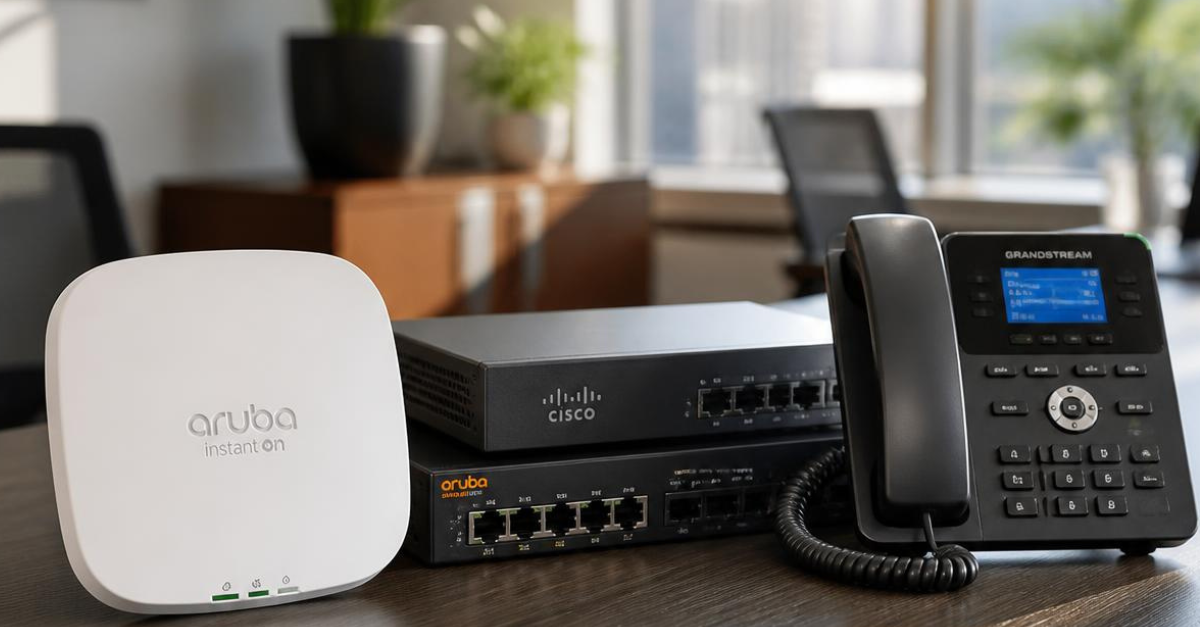
When you standardize a campus network, the brand you choose shapes how you’ll manage, budget and expand for the next decade. Three names come up constantly for education: Aruba (HPE), Cisco Meraki, and Grandstream. Each is a strong choice, but they suit different institutions. This comparison breaks down their strengths so you can match a vendor to your team, budget and goals.
At a glance
| Aruba (HPE) | Cisco Meraki | Grandstream | |
|---|---|---|---|
| Best known for | Robust campus Wi-Fi and switching at scale | Simple cloud-managed everything | Strong value and integrated ecosystem |
| Management | ArubaOS / Central (cloud or on-prem) | Cloud dashboard (subscription) | Free cloud / on-prem controller |
| Sweet spot | Large universities, dense campuses | Lean teams, multi-site visibility | Budget-conscious schools and colleges |
| Licensing | Flexible, hardware-centric options | Subscription required for operation | Generally no recurring license fee |
Aruba (HPE): built for big, dense campuses
Aruba is a mainstay in higher education for good reason. Its access points — from the Aruba AP-505 to the high-density AP-515 and the AP-503H for residences — pair with switches like the 6200F and stackable 3810M for campus-scale aggregation.
Choose Aruba if: you run a large or dense campus, want a single vendor across Wi-Fi and switching, and value the flexibility of cloud or on-premises management without being locked into a subscription to keep the gear running.
Cisco Meraki: simplest to manage across many sites
Meraki’s defining feature is its cloud dashboard. Switches like the MS220-24P and MS225-24P, and Meraki access points, are all configured and monitored from one web console. For an institution with multiple campuses and a small IT team, that single pane of glass is a huge operational advantage.
Choose Meraki if: you have a lean team managing several sites, want remote troubleshooting and live visibility, and are comfortable with the subscription model that the platform requires to operate.
Grandstream: value and an integrated ecosystem
Grandstream delivers capable Wi-Fi 6 and 6E hardware — like the GWN7660 and a tri-band Wi-Fi 6E AP — typically without recurring license fees, and with management options that don’t require a paid subscription. For schools and colleges watching every dollar, that lowers total cost of ownership.
Choose Grandstream if: budget is a primary constraint, you want solid Wi-Fi 6/6E without ongoing licensing costs, and an integrated ecosystem appeals to you.
How to decide
Work through four questions:
- How big and dense is the campus? Very large/dense leans Aruba.
- How big is your IT team and how many sites? Lean team, many sites leans Meraki.
- What’s your tolerance for recurring licensing? Want to avoid it? Lean Aruba or Grandstream.
- What’s the budget? Tight budget leans Grandstream.
Many institutions also run a hybrid — for example, Aruba or Grandstream Wi-Fi with a particular switching choice. There’s no single right answer; there’s a right answer for your institution.
Talk to a vendor-neutral supplier
Because Run-DLJ carries all three brands, we can compare options against your actual requirements rather than pushing one line. Tell us your campus size, team and budget and we’ll lay out the trade-offs — request a quote.
Frequently asked questions
Is Aruba or Cisco Meraki better for a university? Aruba is often favored for large, dense campuses and for institutions that want to avoid mandatory subscriptions. Meraki is favored by smaller teams managing multiple sites who value its cloud dashboard. The best choice depends on campus size, team size and licensing preference.
Does Grandstream work for larger schools? Yes. Grandstream offers Wi-Fi 6 and 6E access points suitable for high-density environments, often at a lower total cost because it typically avoids recurring license fees. Larger schools should validate capacity needs per space.
Can I mix these brands on one campus? You can, and some institutions do. The trade-off is managing more than one platform. Many campuses standardize on one or two brands to simplify operations.
Which brand has the lowest total cost of ownership? It depends on licensing as much as hardware price. Brands that don’t require an ongoing subscription to operate can lower long-term cost, but capacity, support and management efficiency all factor in.
Run-DLJ is a multi-brand Canadian supplier. We’ll help you compare Aruba, Cisco Meraki and Grandstream for your campus. Contact us.